laboratoire écologie et art pour une société en transition
Vivace
As part of its transdisciplinary projects rooted in local communities, least invited author Carla Demierre and artist Anaëlle Clot to co-create a series of works bringing together drawing and poetic writing.
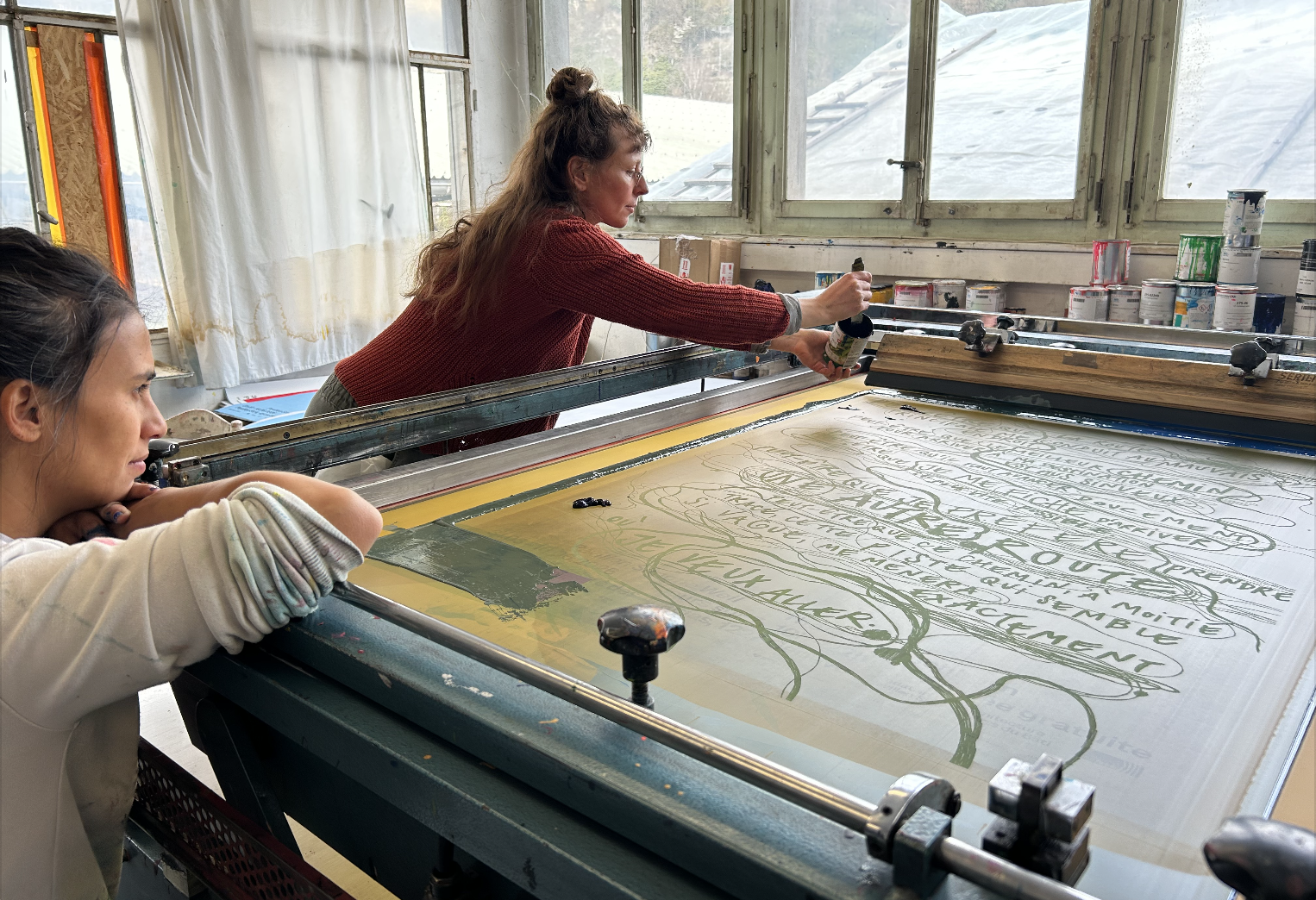
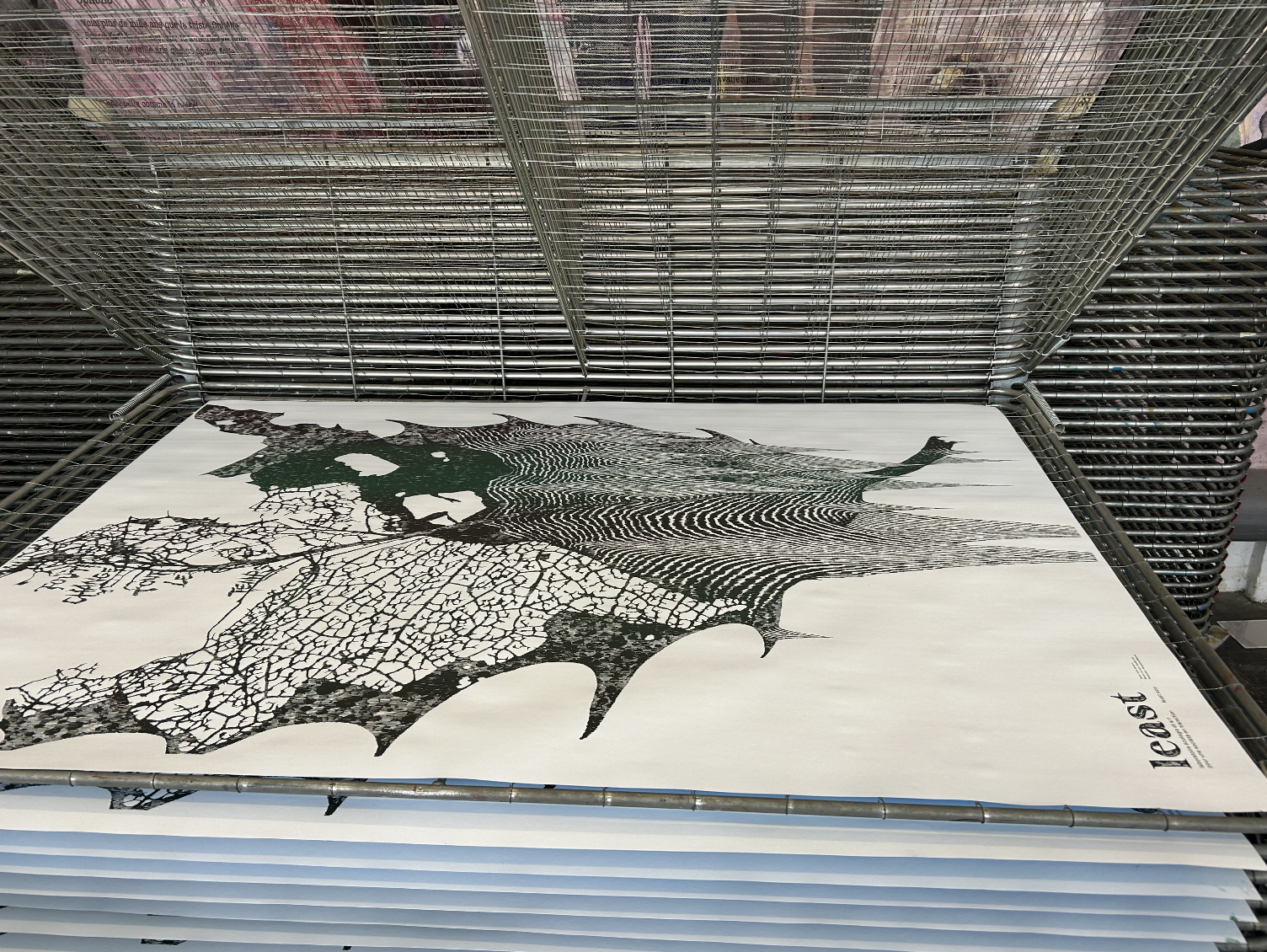
Vivace took the form of a series of ten visual poetry posters displayed in public space. The project formed part of an artistic, ecological and critical reflection on words, visual art and their transformative potential. The starting point was our glossary, developed as a critical tool within our artistic projects: the posters gave visual and poetic form to the concepts it brought together.
The traditional poster format, generally associated with advertising, was repurposed as a medium for poetic expression and transmission. Moving away from normative and commercial logics, these images create spaces for dreaming and reflection within the fabric of everyday urban life, questioning dominant narratives, redirecting attention and opening up spaces for sensory experience.
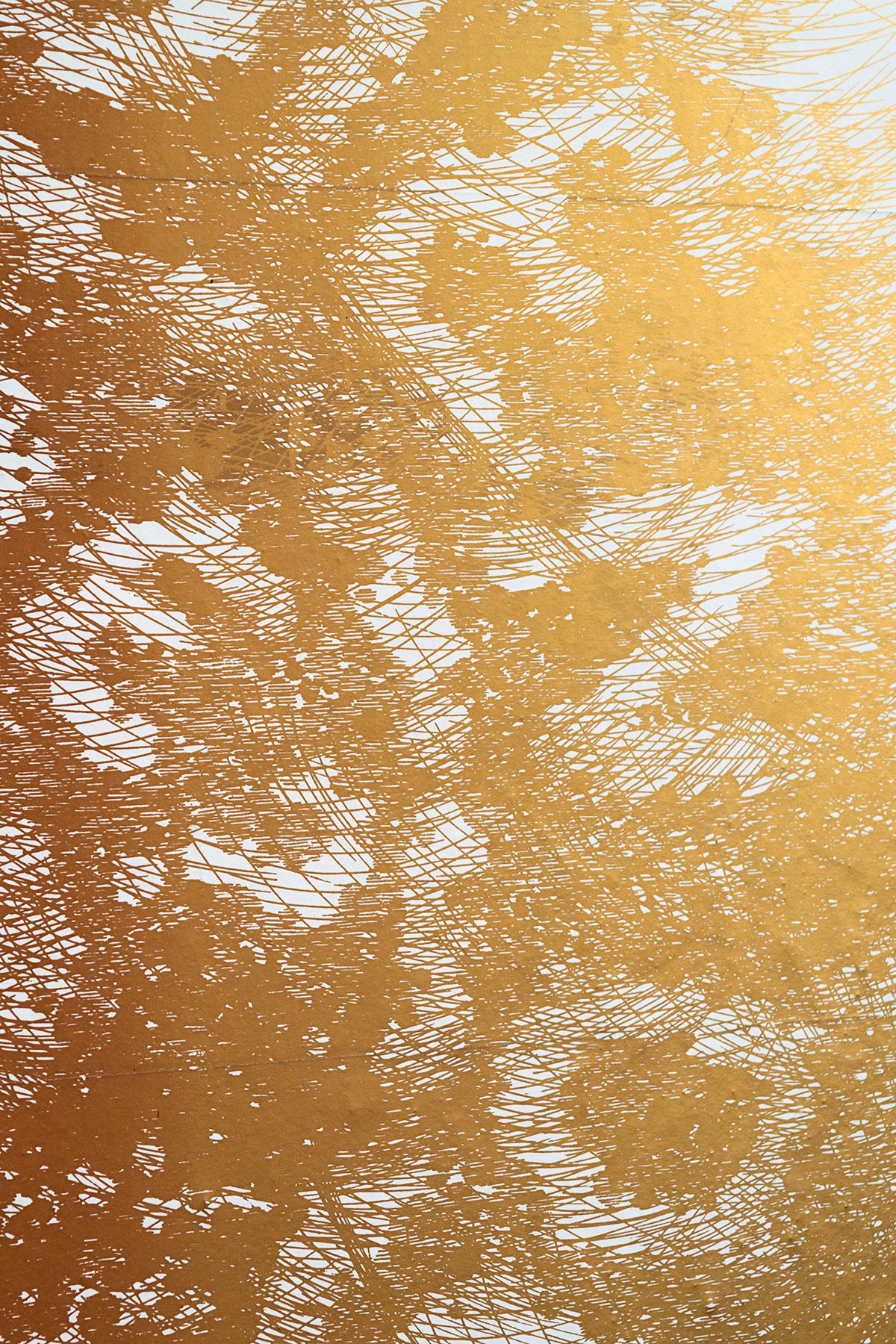
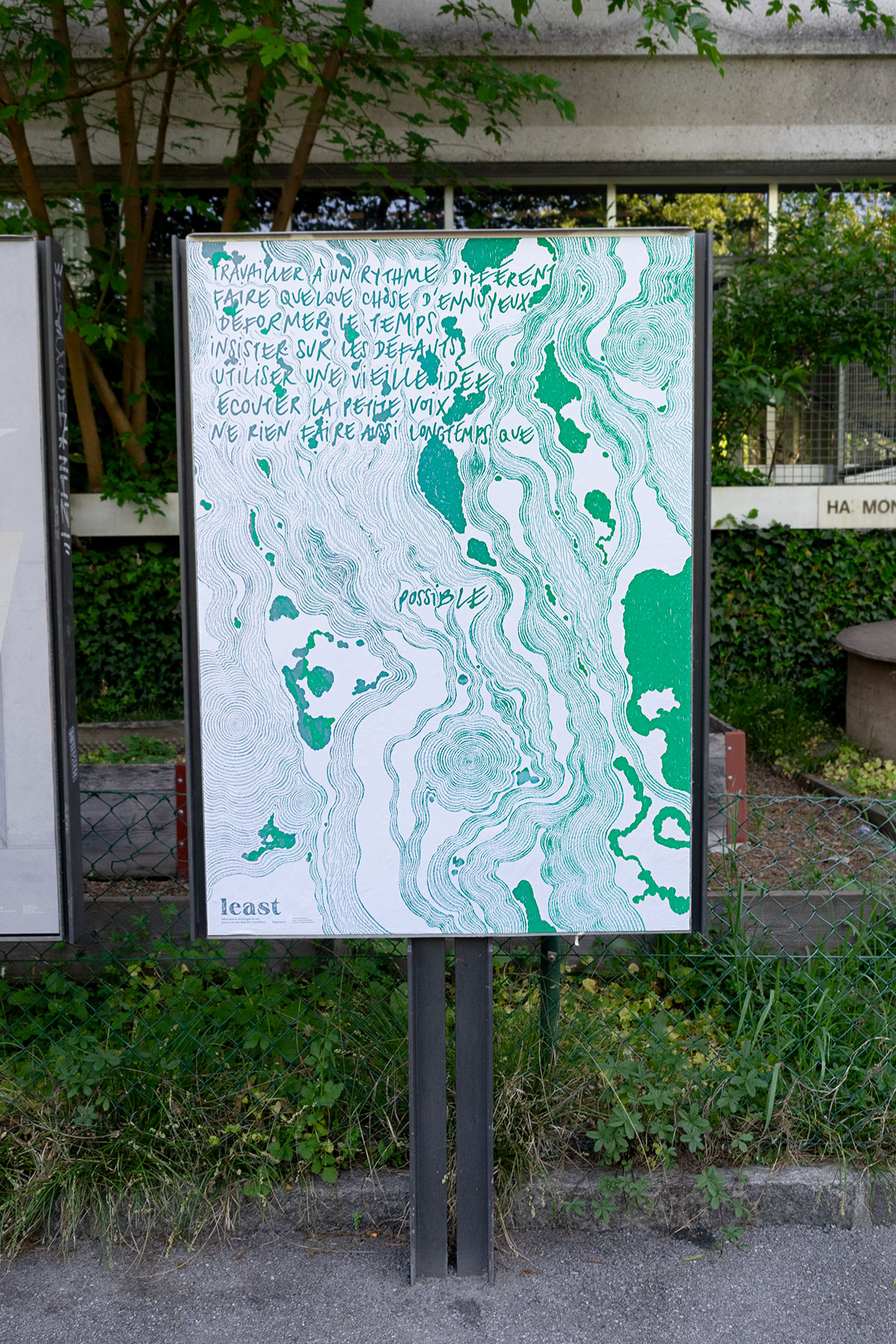
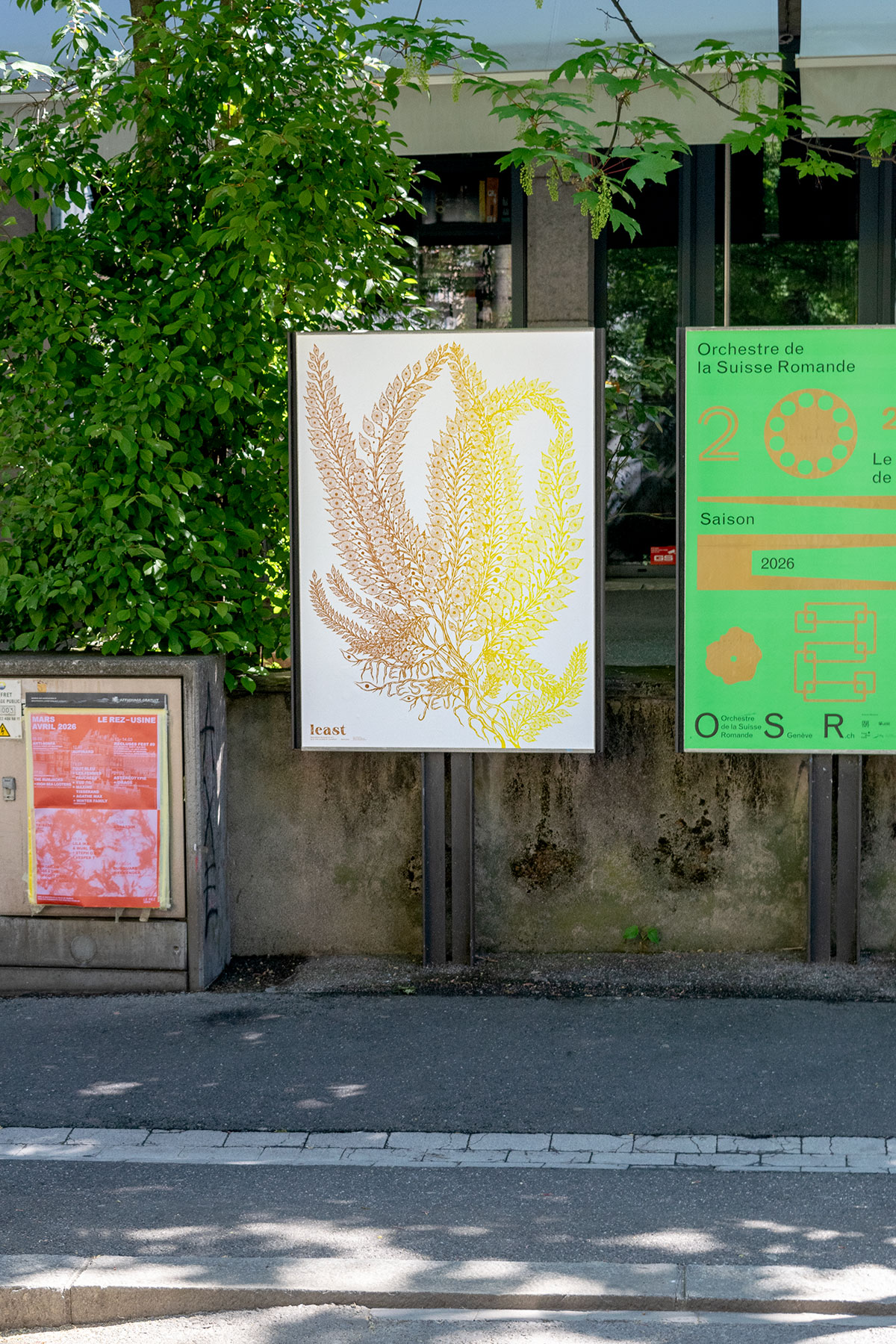
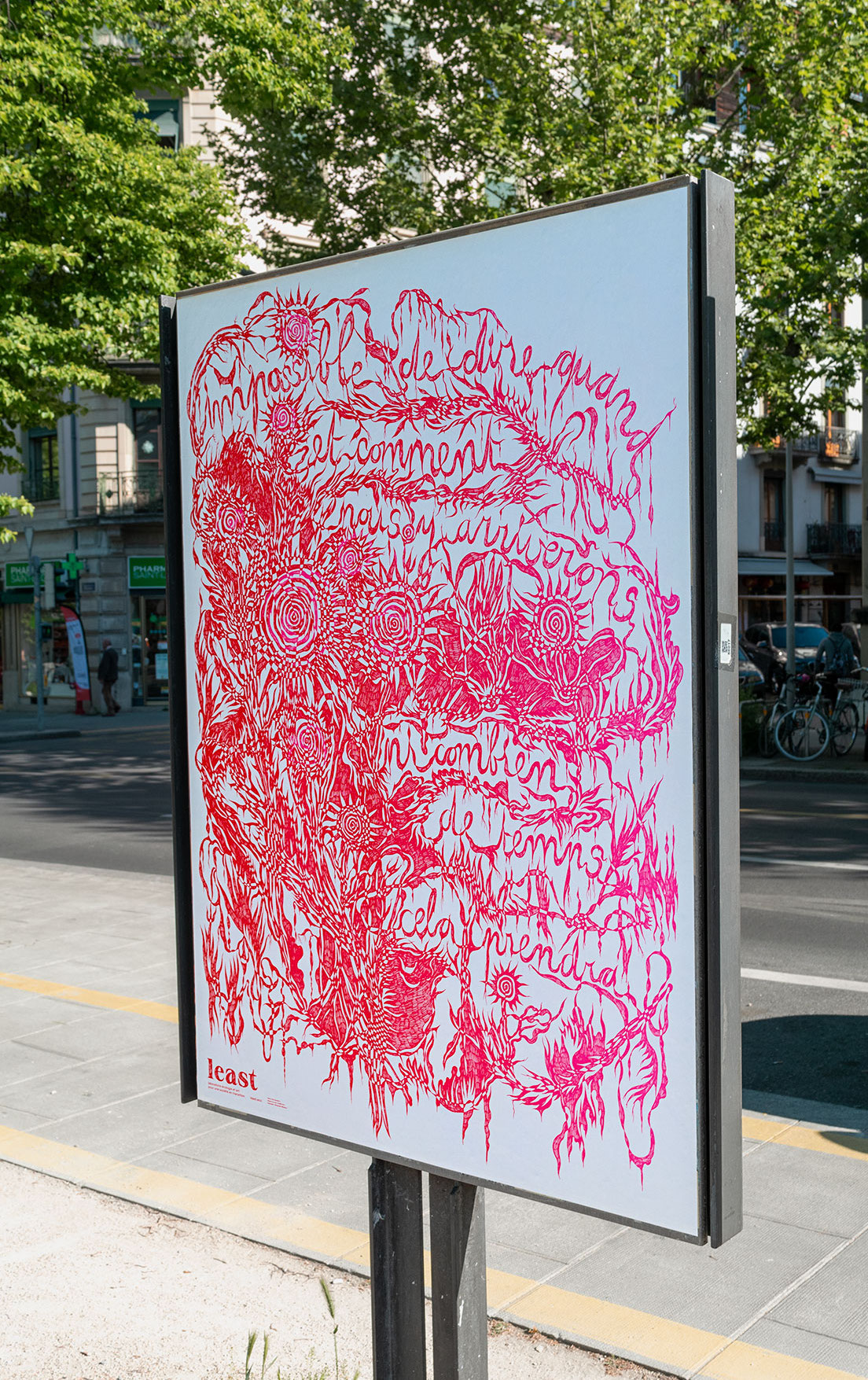
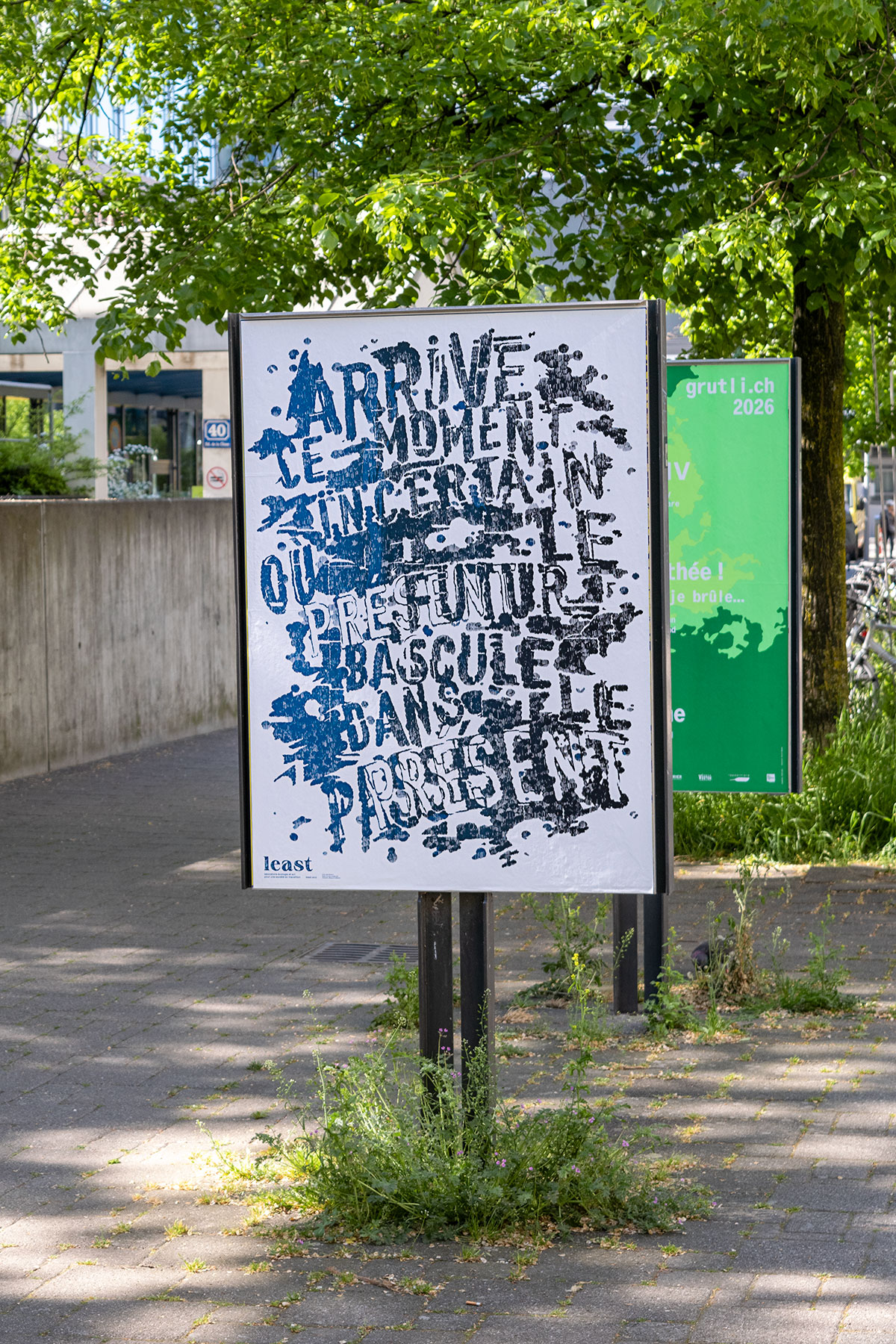
a four-handed language
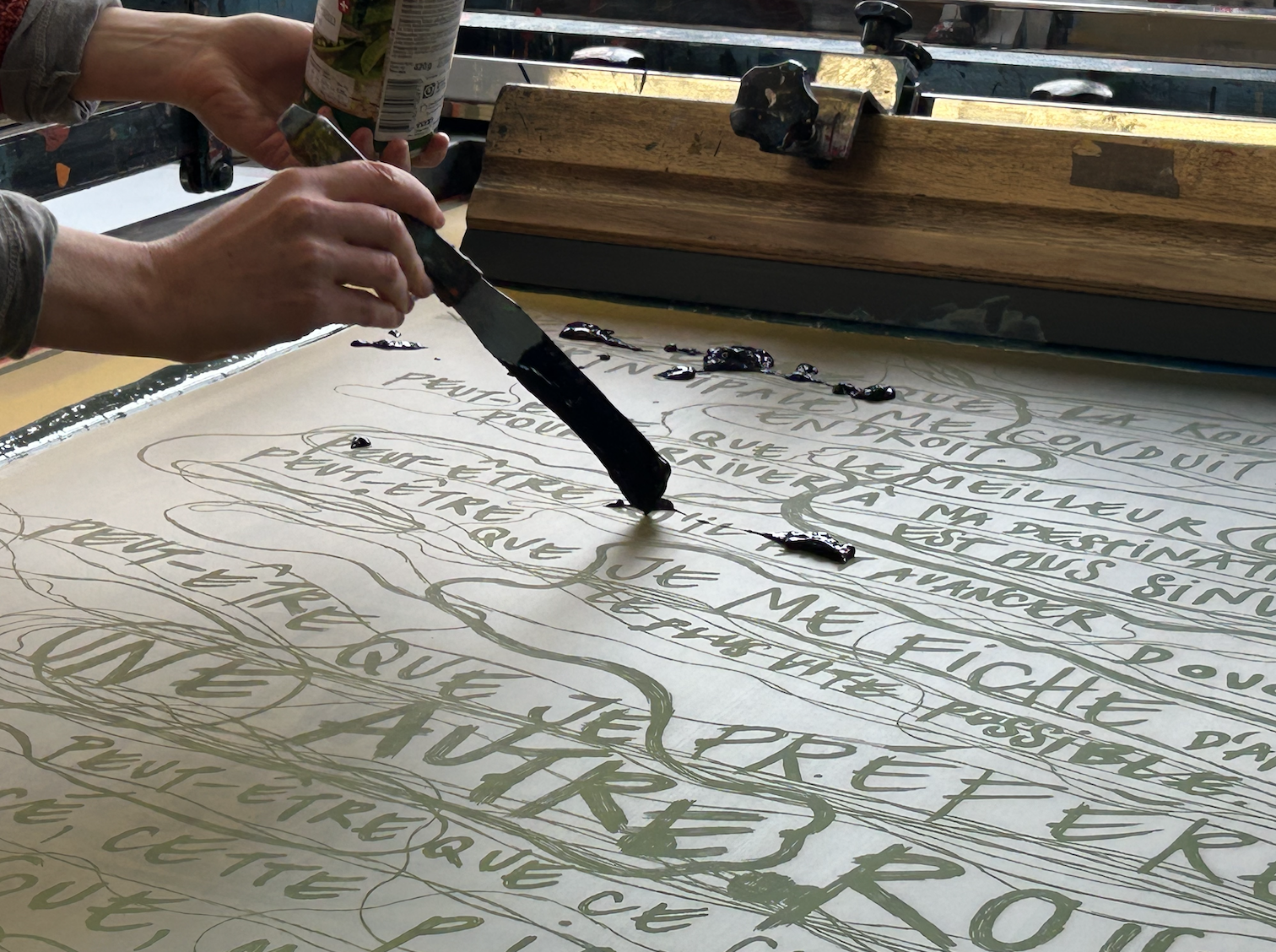
Anaëlle Clot and Carla Demierre developed a dialogue between drawing and writing, with neither medium taking precedence over the other. Words hide, emerge and intertwine with graphic forms to create a material, living language. Drawing on organic textures, more-than-human forms and vegetal intuitions, the ten works offer poetic gestures that seek less to convey a message than to invite us to slow down, observe and feel.
a living trace in the city
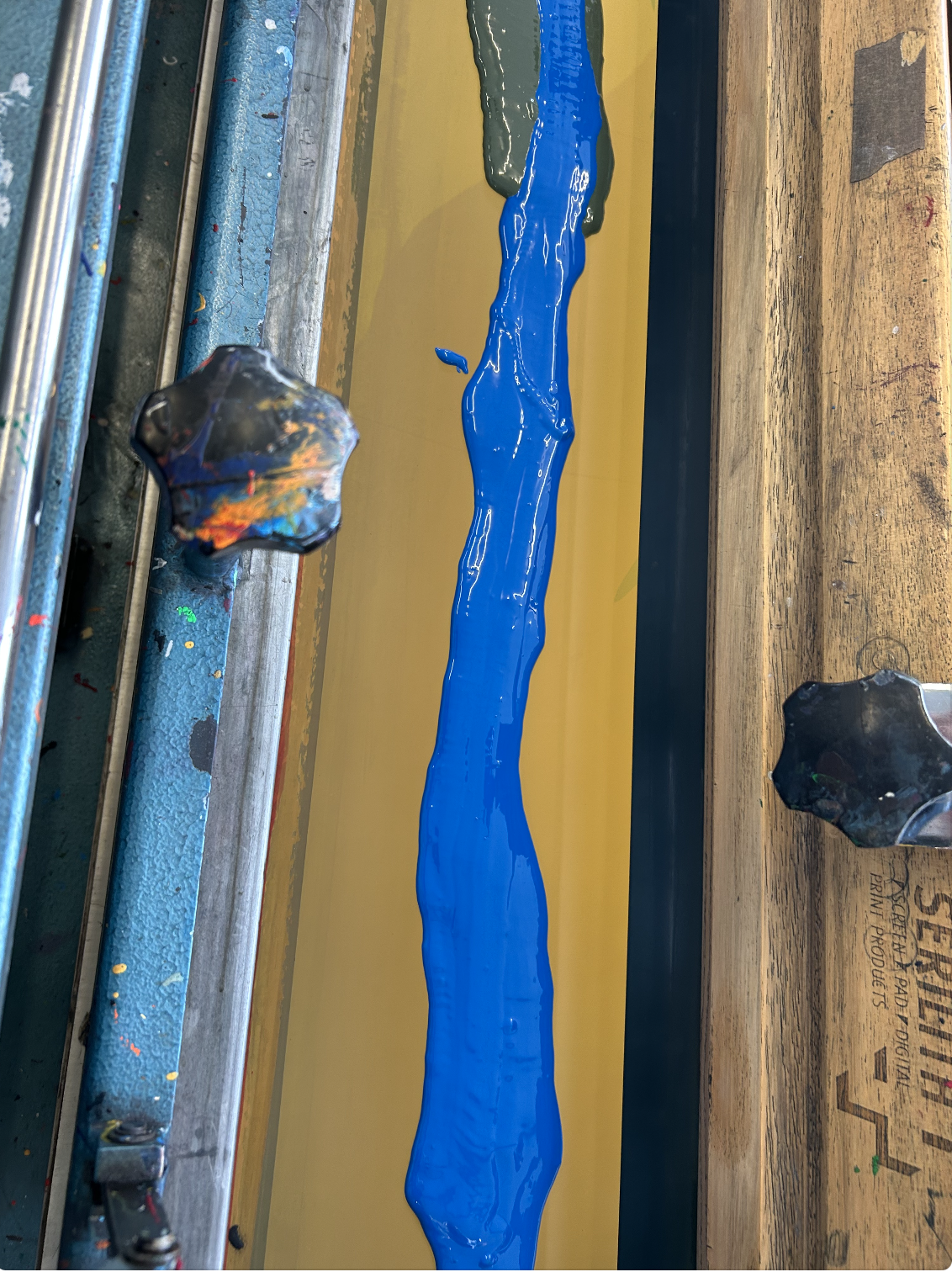
The Vivace posters were produced using artisanal screen printing, a manual process that introduces subtle variations between individual prints, making visible the gestures, materials and time involved in their production. In spring 2026, the works appeared throughout Geneva’s public spaces. Scattered across the city, their singular, organic forms entered into dialogue with the walls, objects and urban landscapes around them, inviting passers-by to slow down and experience the city with renewed attention and sensitivity.
newsletter
All participatory actions and locations will be communicated on our website and via least’s newsletter.
transdisciplinary team
Anaëlle Clot – artist
Carla Demierre - author
Signs, traces, clues
Reading
Carlo Ginzburg and the evidential paradigm.
Devenirs buissons
Vivace
Se rencontrer sur le seuil
d'un champ à l'autre / von Feld zu Feld
Transforming Knowledge
Reading
Every knowledge is rooted in specific contexts and experiences.
Peau Pierre
Faire commun
Cruel optimism
Reading
“Cruel optimism”, according to Lauren Berlant, refers to what grates on our desires and prevents us from carrying on as hoped
least
The Nest
Reading
A poetic reflection by Gaston Bachelard on the nest as a symbol of intimacy, refuge, and imagined worlds.
CROSS FRUIT (ex Verger de Rue)
Faire commun
Se rencontrer sur le seuil
The “life” of objects
Reading
Matter should not be considered as passive and inert, but as infused with intrinsic vitality.
d'un champ à l'autre / von Feld zu Feld
Peau Pierre
Intimity Among Strangers
Reading
Lichens tell of a living world for which solitude is not a viable option
Common Dreams
Faire commun
CROSS FRUIT
A Sub-Optimal World
Reading
An interview with Olivier Hamant, author of the book “La troisième voie du vivant”.
Common Dreams
CROSS FRUIT
Faire commun
Signs, traces, clues
An art lover enters a museum. It is not his first visit, yet each time still feels exceptional. In Europe, public museums are still rare, and his profession as a physician leaves him little time to devote to his most cherished pastime. He sits on a bench before the painting he has chosen to study and remains there for a long while, silent, observing. Over the years, he has developed a personal discipline of attention, a technique of memory that allows him to preserve in his mind what he will soon have to leave behind. There is something cruel about the passion for art: once you step away from a work, you can rely only on your memories or on imperfect reproductions engraved and printed in black and white by some copyist.
After a while, he takes out his notebook and begins to draw; not the whole scene, but the details of the bodies depicted in the painting: the conch and lobe of the ears, the outline of the nails, the shape of the feet. At first, he had taken up this exercise out of professional habit, guided by the anatomical curiosity of a man accustomed to observing the diversity of human bodies. Over time, however, by copying and recopying these particular features, he has arrived at a singular conviction: to recognise the hand of a painter, one should not look so much at the overall style or the palette—which can be imitated—but at those details executed almost absentmindedly, with a quick gesture, less constrained by convention and closer to the artist’s individuality. It is a method of recognition akin to that used in clinical medicine, which must often rely on the fragmentation of symptoms in order to infer the underlying disease.
We are in the nineteenth century. The man seated before the painting is named Giovanni Morelli and he does not yet know that, a few decades later, the method he is slowly developing will influence not only the history of art but other fields of knowledge as well. Sigmund Freud himself would later recognise something strangely familiar in the approach of this great connoisseur and would write: “Psychoanalysis proceeds in the same way: it attaches particular importance to what appears insignificant, to the refuse and debris of observation, in order to discover secret or concealed things.” Indeed, in psychoanalytic practice, truth does not reveal itself in the most coherent and carefully organised speeches, but in the deviations: a slip of the tongue, an apparently secondary detail, a contradiction in the narrative. The analyst attends to what seems marginal, because it is precisely in these fissures that something may emerge that escapes conscious control.
A few centuries earlier, in Venice, a tale of Persian origin is printed: The Three Princes of Serendip. The story recounts the journey of three young princes who encounter a man distraught over the loss of his camel. Before he even has time to explain, the three princes begin asking him a series of astonishingly precise questions. Was the camel, they ask, perhaps blind in one eye? Was it, by chance, lame? Did it carry butter on one side and honey on the other? And had it not been ridden by a pregnant woman?
Troubled by such precision, the man concludes that the three must have stolen the animal and openly accuses them. Cornered, the princes explain that not only have they not stolen it, but they have never even seen it. Along the road, they say, they simply noticed certain details: the grass had been grazed only on the poorer side of the path, suggesting that the animal could see out of only one eye. One of the tracks, dragged through the sand, indicated an injured leg. Farther along, the insects gathering revealed that butter had leaked from one side of the load, attracting ants, while honey dripping from the other side had drawn flies. Finally, near the spot where someone had stopped to urinate, handprints could be seen in the soil: a sign that the person who stood up had needed to push themselves up with both hands—something that might happen to a pregnant woman.
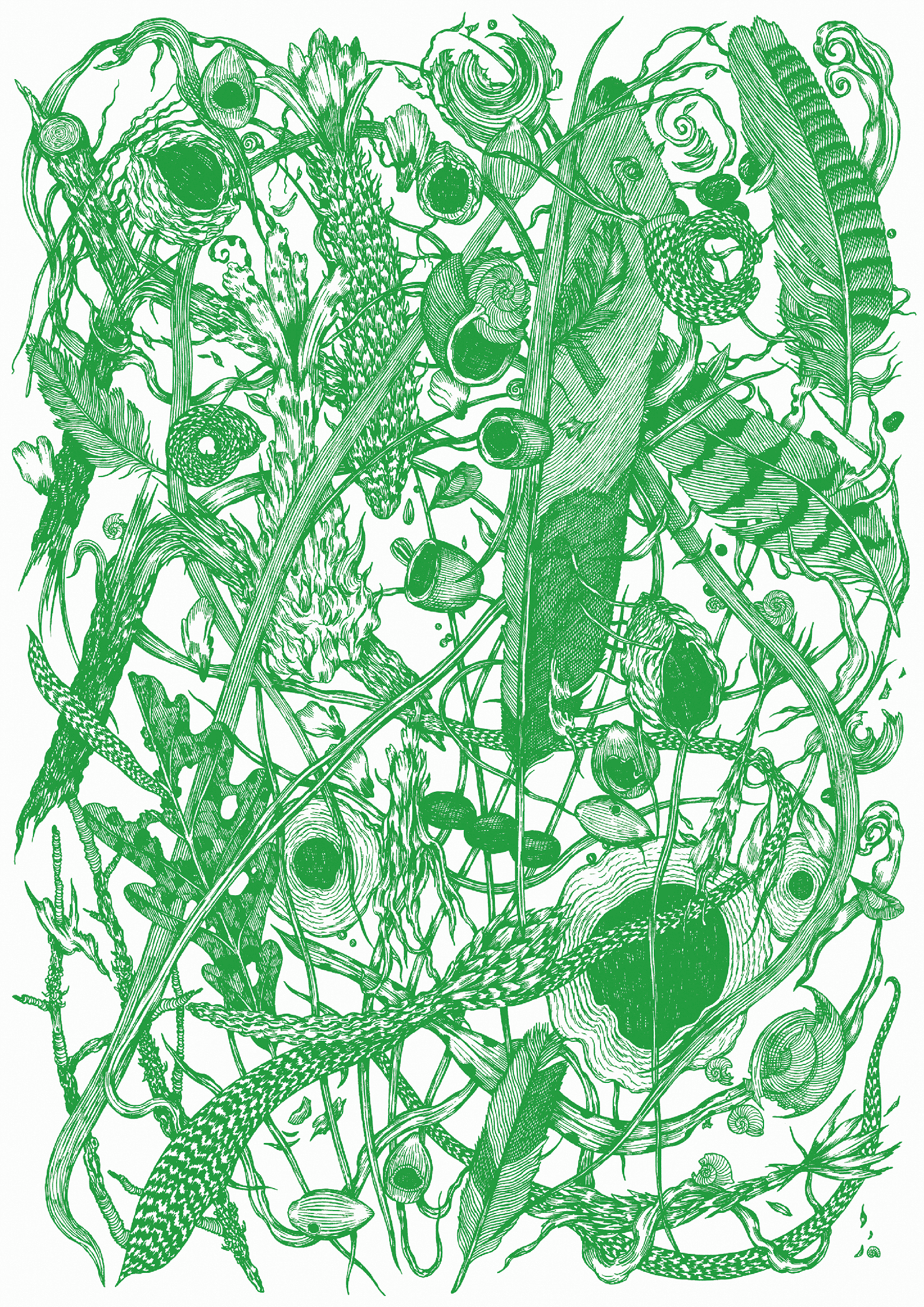
Drawing: © Anaëlle Clot
Finally, one last and very long leap back in time. A person walks slowly across a muddy plain under a light rain. They are not looking into the distance, as someone trying to orient themselves in the landscape might do; their gaze remains fixed on the ground. At first glance, the terrain appears uniform. But it takes only a moment of bending down and paying close attention to realise that it is anything but: the brown surface is dotted with fresh, deep footprints leading toward a grove of birch trees. Here and there, blades of grass lie flattened, tufts of hair cling to the low branches of bushes. A little farther on, a few still-warm droppings slowly dissolve into the mud. An animal passed through here not long ago. It walked with a heavy step, perhaps tired from the hunt and the meal that followed. Perhaps it is now hiding in the grove, where among the trees there is a pond to drink from and thickets in which to take shelter. Night will soon fall. It would be wiser to keep one’s distance.
What unites these episodes scattered across time—episodes to which the historian Carlo Ginzburg alludes in his essay Clues: Roots of an Evidential Paradigm—is the same mental operation. In each case, someone finds themselves confronted with a reality that cannot be observed directly and must be reconstructed from clues: a minor detail in a painting, something that catches the eye along the edge of a road, a slip of the tongue in a conversation, footprints in the mud. The event itself is no longer present, yet it has left behind a series of scattered signs. The work of knowledge consists precisely in connecting them, patiently, until plausible patterns begin to emerge, much like a detective in a crime novel.
Drawing on examples such as these, Ginzburg proposed recognising the existence of a particular form of knowledge that cuts across very different disciplines, which he called the “evidential paradigm”. It is a way of knowing that proceeds less through general laws or abstract demonstrations than through the interpretation of clues—tiny, marginal signs that, if observed with sufficient attention, allow one to trace back to a broader reality. In this kind of knowledge, what appears individual or singular is not a residue to be eliminated in order to reach a more stable generalisation. On the contrary, it is the very point from which knowledge—situated knowledge—takes its momentum. This amounts to a genuine epistemological revolution: to consider the unrepeatable as the very condition that makes interpretation possible overturns a long tradition of scientific thought that sought, instead, to ground knowledge in the elimination of the particular.
In the 1970s, it was precisely around this intuition that what came to be called microhistory began to develop in Europe. Figures such as Ginzburg, Giovanni Levi and Carlo Poni proposed complementing the great structural syntheses of historical scholarship with close attention to marginal subjects: the community of a village, a judicial trial, the trajectory of a particular individual. The term micro does not so much refer to the size of the object of study as to a change in the scale of observation: looking closely makes it possible to perceive tensions, practices and forms of experience that remain invisible when the historical landscape is observed from too great a distance. As Giovanni Levi writes, it is a “search for truth related to the conflictual and active way in which people act in the world”, a search that proceeds through knowledge of the individual without renouncing precision or scientific ambition. This way of looking closely, of paying attention to details and situated experiences, resonates strongly with the way we work within least. When we carry out investigations in a territory in order to imagine co-creative artistic projects, we often adopt a similar approach: we focus on the micro scale—practices, narratives, uses—and place great value on lived experience, which complements and sometimes shifts theoretical frameworks.
The evidential paradigm also highlights a broader tension in the history of science. Since the early modern period, many disciplines have sought to ground their legitimacy in the use of quantitative instruments, in the ability to measure, to count and to establish statistical regularities. Yet there are domains of knowledge, such as the human sciences, where understanding cannot dispense with a confrontation with the singular case, with what cannot be reduced to a numerical series. The symptom of a patient, the handwriting of a manuscript, an archival testimony, these are not simply data among others. They are individual signs that demand interpretation, that escape any attempt at measurement and that carry a profound significance.
The evidential paradigm may appear to be a merely refined epistemological problem, but it is in fact a method that highlights the importance of experience and that, quite coherently, has its roots in a practice: hunting—the reading of traces left on the ground, the deduction of an invisible presence from signs scattered across the landscape. Some scholars have indeed suggested that a first form of narrative thinking may have emerged within hunting societies: the cognitive capacity, which we share with other animals, to connect dispersed signs into a coherent sequence of events. Footprints embody the paradox of a presence that is no longer there yet can be reconstructed from the traces it has left behind. Perhaps it is from this experience that a more general capacity arose: the ability to think in symbols and signs. Through many transformations, this capacity leads to art, to speech, to writing and to history itself: this very page where I, who wrote a few days ago, and you, who are reading at this moment, coexist—and from which someone, many years from now, may perhaps infer something about the beginning of the twenty-first century.
Transforming Knowledge
Knowledge – and scientific knowledge in particular – is often perceived as something neutral, universal and abstract. This illusion, which lends it authority and prestige, conceals the fact that all knowledge is rooted in specific contexts and embodied in experiences. Every act of research is born of an encounter with matter and with others. It is within this tension that many contemporary theories have mounted a radical critique of the dominant view, inviting us instead to think of knowledge as an embodied, relational experience.
In Situated Knowledges, Donna Haraway dismantles the fiction of “objective” science. She reminds us that every gaze is always partial and situated: there is no neutral point of view, only embodied perspectives, i.e. perspectives that carry responsibility and call for a “science project that offers a more adequate, richer, better account of a world, in order to lie in it well and in critical, reflexive relation to our own as well as others’ practices of domination and the unequal parts of privilege and oppression that make up all positions. In traditional philosophical categories, the issue is ethics and politics perhaps more than epistemology.” For Haraway, objectivity does not mean hypocritically erasing partiality but rather making it explicit and owning up to the relationships that make it possible. This shift transforms science into what she calls a “successor science”: no longer the abstract possession of universal truths, but a situated practice that acknowledges its grounding in bodies and histories.
In bell hooks’ pedagogy, this principle takes on a concrete form. In Teaching to Transgress, the classroom is not portrayed as a neutral space for the transmission of knowledge, but as a place shaped by identities, emotions, desires and reciprocal relations. Teaching becomes a “practice of freedom”: not merely the communication of content, but the opening up of a space where lived experience rightfully enters the learning process and where pedagogical formats are continually re-examined and co-created collectively within what hooks calls the learning community. In contrast to the academic ideal of aseptic, disembodied didactics, hooks – writing from her position as a Black woman in a white university – asserts the value of the body, of personal histories and of process itself as necessary conditions of learning. For hooks, the aim of teaching is to guide action and reflection in order to transform the world, to convert the will to know into a will to become.
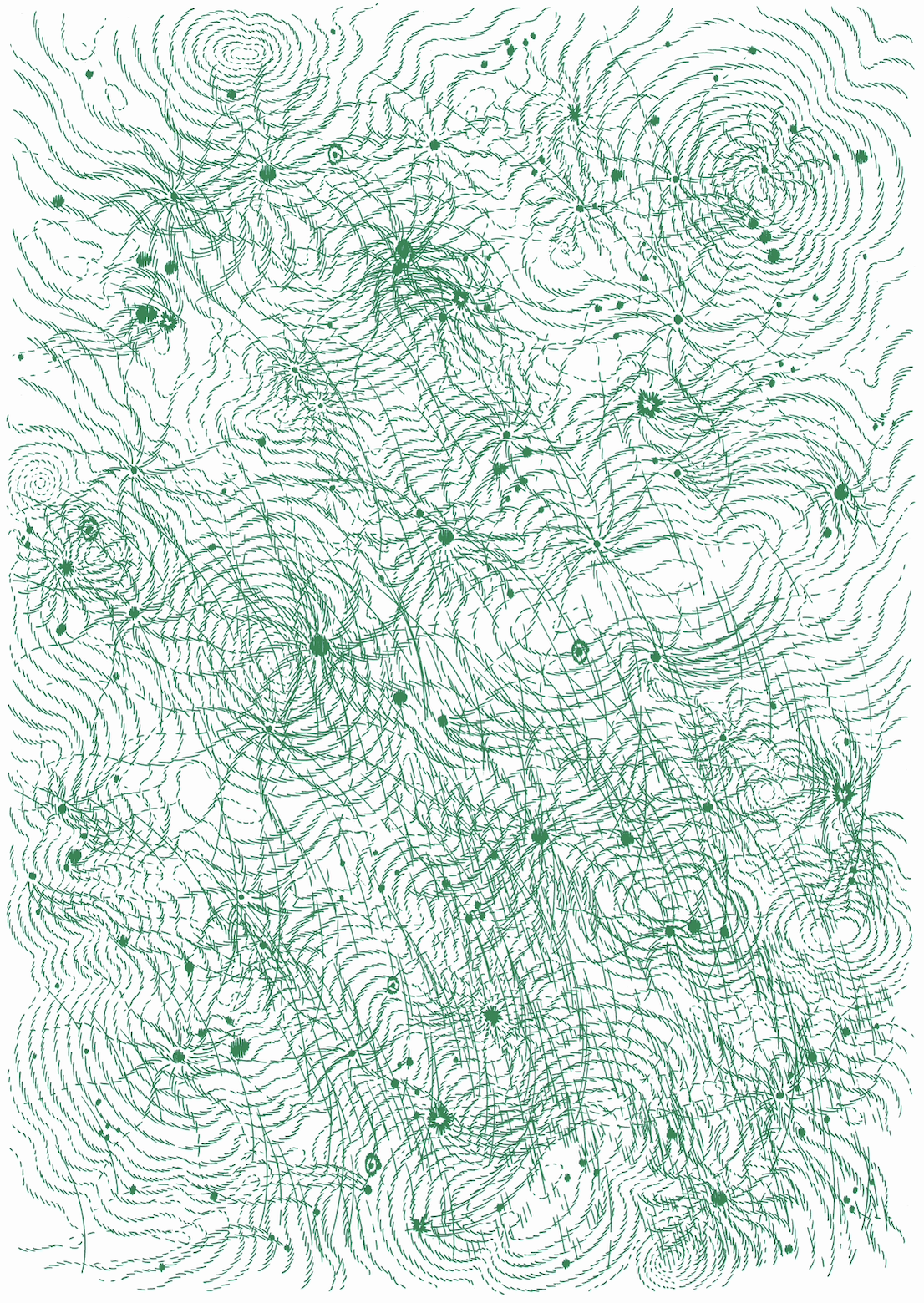
Drawing: Anaëlle Clot.
Another influential position in this regard can be found in Eduardo Viveiros de Castro’s writings on Amerindian perspectivism, which he defines as the idea “that the world is inhabited by different kinds of subjects or persons, human and non-human, who apprehend reality from distinct points of view.” At first glance, this might sound like relativism, but in fact it overturns the relativist hypothesis: it is not that there is a single physical “nature” interpreted by a plurality of cultures. For perspectivism, on the contrary, there is a single culture, shared by all beings, including non-human animals, who see themselves as persons and participate in sociality and belief. What exists instead is a multiplicity of “natures”, since each type of being perceives and inhabits a different world. Thus, jaguars see blood as manioc beer: what might appear to us as an objective given is, within this cosmology, the result of an embodied perspective. One consequence of this ontology is a reversal of the Western conception of culture: “creation-production is our archetypal model of action (…) while transformation-exchange would probably fit better the Amerindian and other non-modern worlds. The exchange model of action supposes that the other of the subject is another subject, not an object; and this, of course, is what perspectivism is all about.”
With Making by Tim Ingold, the discourse on embodied knowledge is tightly interwoven with the experience of making. Rather than the accumulation of data, he values the cultivation of a sensitive, bodily attention, “against the illusion that things can be ‘theorised’ independently of what is happening in the world around us.” From this perspective, “the world itself becomes a place of study, a university that includes not just professional teachers and registered students, dragooned into their academic departments, but people everywhere, along with all the other creatures with which (or whom) we share our lives and the lands in which we – and they – live. In this university, whatever our discipline, we learn from those with whom (or which) we study. The geologist, for example, studies with rocks as well as with professors; he learns from them, and they tell him things. Likewise, the botanist studies with plants and the ornithologist with birds.” Hence his critique of traditional academic forms, which claim to explain the world as if knowledge could be constructed after the fact, by excluding the body and practice. For Ingold, by contrast, thinking and making are inseparable: “materials think in us, as we think through them.” It is in this spirit that the introduction of artistic and manual practices into his teaching plays a central role: it demonstrates that knowledge arises from the experimenting body, in correspondence with materials that actively take part in transformation. The ultimate aim is not to document from the outside, but to transform: if learning changes us, it must also be given back to the world, opening up other possibilities of relation.
These diverse voices converge on a single point: knowledge is never detached from the world, but takes shape through its interaction with bodies, materials and relationships. This is not to deny the rigour or the importance of academic institutions, but to stress that knowledge is diminished when it erases the embodied and situated conditions from which it arises. Focusing on these dimensions is to transform knowledge, from an instrument of domination into an ecological practice of coexistence, where disciplinary boundaries blur and description gives way to collective, transformative experience. It is within this space of research and experimentation that least positions its work: approaches that bring together transdisciplinary teams in which everyone has an equal place and commits to crossing the frontiers of their own discipline; approaches that privilege process over outcome; and approaches that, through artistic practice, open new ways of developing and transmitting knowledge.
Cruel optimism
“A relation of cruel optimism exists when something you desire is actually an obstacle to your flourishing. It might involve food, or a kind of love; it might be a fantasy of the good life, or a political project. It might rest on something simpler, too, like a new habit that promises to induce in you an improved way of being. These kinds of optimistic relation are not inherently cruel. They become cruel only when the object that draws your attachment actively impedes the aim that brought you to it initially.”
These are the opening words of Cruel Optimism, a book by theorist Lauren Berlant that, in recent years, has become a key reference for anyone thinking seriously about affect, desire and precarity.
Who hasn’t, at least once, believed that working harder than necessary would help us get ahead? Or that a toxic relationship was better than being alone? Or that political commitment, on its own, could truly change things? All these promises eventually start to creak. And behind that creaking, Berlant identifies a deeper, more pervasive feeling that runs through many contemporary lives: the impasse – a condition in which we keep moving forward without really knowing where we’re going, where we’re surviving more than living, where change is both longed for, feared and always somehow postponed.
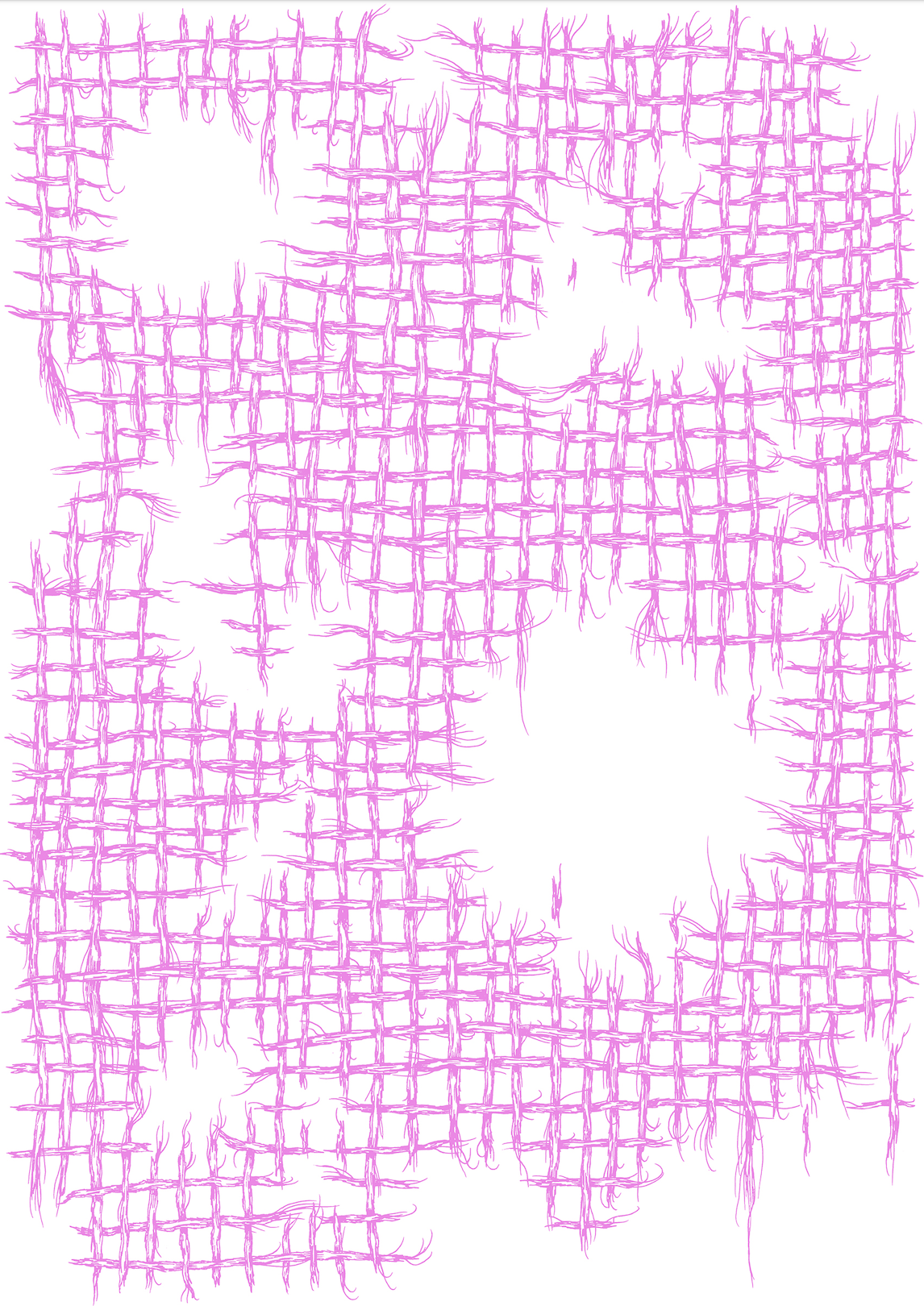
Drawing: Anaëlle Clot.
But Berlant doesn’t stop at diagnosis. They invite us to pay attention to the micro-tactics through which people try to survive within the impasse. They call these forms “self-interruption”: tiny gestures like eating erratically, compulsively scrolling, binge-watching endless series, procrastinating – things we often regard as bad habits or self-sabotage. Yet in Berlant’s reading, these are also reprieves, pauses in the relentless push for productivity, fleeting moments where the self finds shelter; acts that, while they may not change the world, express a desire to keep going and in that very persistence, carry a quiet political force.
To live in an exhausting world and somehow manage – even just for today – not to fall apart, is already a form of resistance.
Perhaps, then, we might learn something from this stance: to be gentler with ourselves, to allow space for rest, for emptiness, for pause. To accept doing nothing, from time to time, can be an act of care. And it is also a way of desiring a more liveable world.
The Nest
Here is an excerpt from The Poetics of Space by 20th-century French philosopher Gaston Bachelard. In this work, Bachelard explores spaces of human intimacy – houses, drawers, nooks, nests – not as physical objects, but as places imbued with life and imagination. The passage featured is a poetic and thoughtful meditation on the nest, viewed as a vital refuge, the centre of a universe that is both real and imagined.
It is the living nest, however, that might introduce a phenomenology of the real nest, the nest found in nature, which becomes, for a fleeting moment (and the word is not too grand), the centre of a universe, the marker of a cosmic situation. I gently lift a branch, the bird is there, brooding on its eggs. It does not fly away. It only trembles, slightly. I tremble at making it tremble. I fear that the nesting bird knows I am a man, that being who has lost the trust of birds. I remain still. Slowly – so I imagine – the bird’s fear and my fear of causing fear subside. I breathe more easily. I let the branch fall back. I’ll return tomorrow. But today, I carry a quiet joy: the birds have built a nest in my garden.
And the next day, when I return, walking even more softly, I see, at the bottom of the nest, eight eggs of a pale pinkish white. My God! How small they are! How tiny a hedge bird’s egg is!
There is the living nest, the inhabited nest. The nest is the bird’s home. I’ve long known this, it’s long been said to me. It’s such an old truth that I hesitate to repeat it, even to myself. And yet I have just relived it. I recall, with a clear and simple memory, those rare moments in life when I have discovered a living nest. How few and precious are such true memories in a lifetime!
I now fully understand Toussenel’s words:
“The memory of the first bird’s nest I found on my own has remained more deeply etched in my mind than that of the first Latin prize I won at school. It was a lovely greenfinch’s nest with four grey-pink eggs, traced with red lines like a symbolic map. I was struck on the spot by an unspeakable joy that rooted me there for over an hour. It was my calling that chance revealed to me that day.”
What a beautiful passage for those of us seeking the sources of our earliest fascinations! When we resonate, even from afar, with such a shock, we better understand how Toussenel could integrate, in both life and work, the harmonic philosophy of Fourier, adding to the bird’s life an emblematic dimension, a universe of meaning.
And even in ordinary life, for someone who lives among woods and fields, the discovery of a nest is always a fresh emotion. Fernand Lequenne, the plant lover, walking with his wife Mathilde, spots a warbler’s nest in a blackthorn bush:
“Mathilde kneels down, reaches out a finger, brushes the fine moss, holds her hand there, suspended…
Suddenly, I shudder.
I’ve just discovered the feminine meaning of the nest, perched in the fork of two branches. The bush takes on such human significance that I cry:
– Don’t touch it, whatever you do, don’t touch it!”
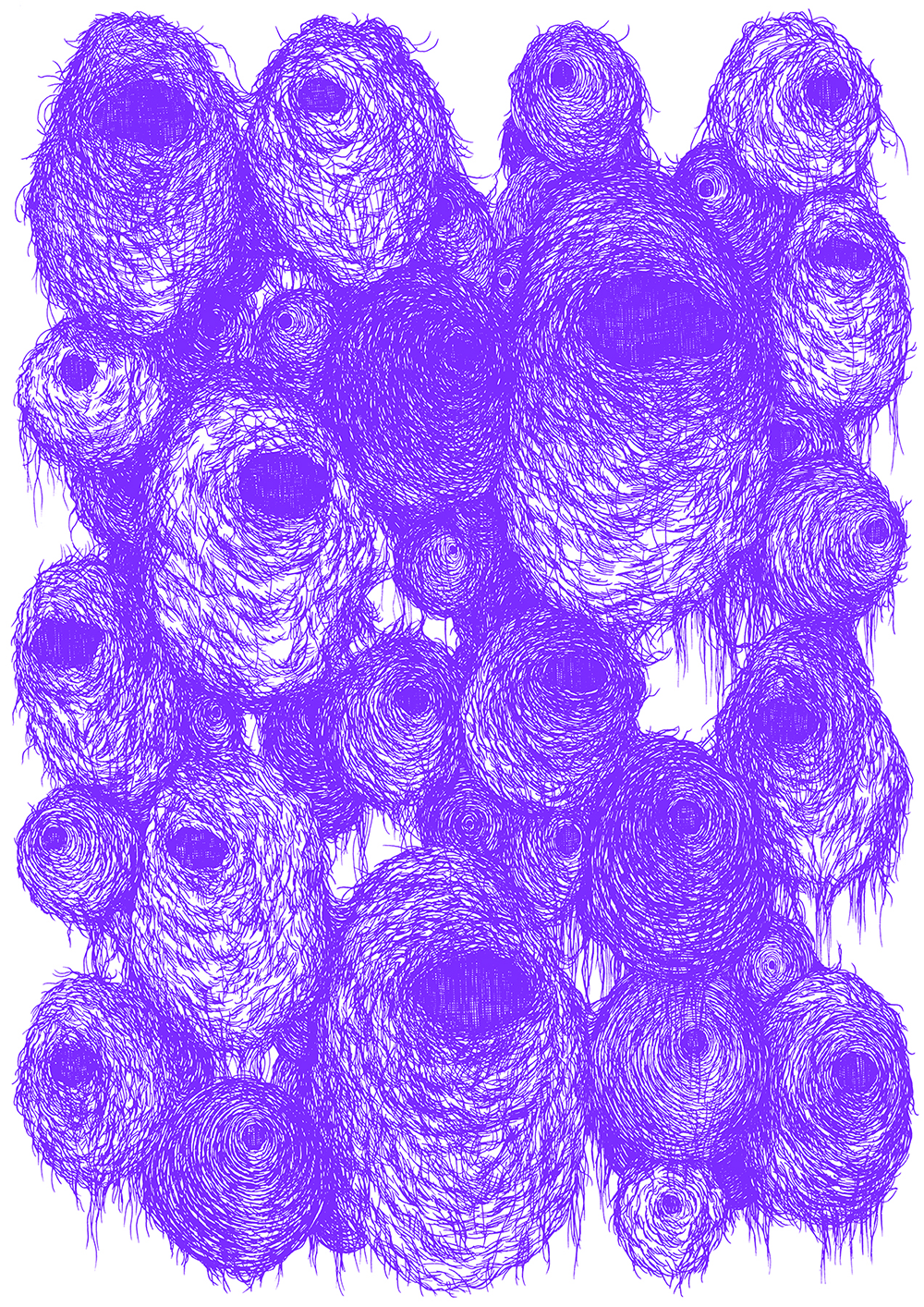
Drawing: Anaëlle Clot.
Toussenel’s shock, Lequenne’s shudder, both carry the unmistakable mark of sincerity. We echo them in our reading, since it is often in books that we experience the thrill of “discovering a nest.” Let us then continue our search for nests in literature.
Here is an example where a writer intensifies the nest’s role as home. We have borrowed it from Henry David Thoreau. In his writing, the entire tree becomes, for the bird, the vestibule of its nest. Already, the tree that shelters a nest partakes in the mystery of the nest. For the bird, the tree is a refuge.
Thoreau shows us the woodpecker making a home of the whole tree. He compares this act of possession to the joyful return of a family moving back into a long-abandoned house: “Just as when a neighbouring family, after a long absence, returns to their empty home, I hear the joyful sounds of voices, the laughter of children, and see smoke rising from the kitchen. The doors are flung wide open. The children race through the hall, shouting. So too, the woodpecker darts through the maze of branches, drills a window here, bursts out chattering, dives elsewhere, ventilates the home. It calls out from top to bottom, prepares its dwelling… and claims it.”
Thoreau gives us, all at once, the nest and the house unfolding. Isn’t it striking how his text breathes in both directions of the metaphor: the joyful house becomes a vibrant nest – and the woodpecker’s trust, hidden in its tree-nest, becomes the confident claiming of a home.
Here, we go beyond mere comparison or allegory. The “proprietor” woodpecker, appearing at the tree’s window, singing from its balcony, a critical mind might call this an “exaggeration.” But the poetic soul will be grateful to Thoreau for expanding the image, giving us a nest that reaches the size of a tree.
A tree becomes a nest the moment a great dreamer hides in its branches. In Memoirs from Beyond the Grave, Chateaubriand shares such a memory: “I had built myself a perch, like a nest, in one of those willows: there, suspended between earth and sky, I would spend hours with the warblers.”
Indeed, when a tree in the garden becomes home to a bird, it becomes dearer to us. However hidden, however silent the green-clad woodpecker may be among the leaves, it becomes familiar. The woodpecker is no quiet tenant. And it’s not when it sings that we think of it, but when it works. All along the tree trunk, its beak strikes the wood with resonant blows. It often vanishes, but its sound remains. It’s a labourer of the garden.
And so, the woodpecker has entered my sound-world. I’ve turned it into a comforting image. When a neighbour in my Paris flat hammers nails into the wall late into the evening, I “naturalise” the noise. True to my method of making peace with anything that disturbs me, I imagine myself back in my house in Dijon, and I say to myself: “That’s just my woodpecker, working away in my acacia tree.”
The “life” of objects
The relationship between human beings and objects, between subject and matter, is traditionally considered in terms of use, or even domination. Western philosophy, with a few exceptions, has generally made a strict distinction between the human world and the world of things, attributing to the former an absolute primacy in terms of agency and intentionality. Nevertheless, in our daily experience, this separation between us and the world of objects is much more nuanced, dynamic and interactive.
From a pragmatic point of view, one need only think of the myriad of technologies that surround us, from forks to computer networks that influence our lives. On a symbolic level, objects also play a fundamental role in the construction of individual and collective identities, actively participating in the formation of cultural, emotional and social representations. From this perspective, the strict distinction between subject and object fades away, giving way to a more complex network of mutual interactions.
In this context, American theorist Jane Bennett came up with the concept of “vibrant matter”. Matter should not be considered as passive and inert, but as infused with intrinsic vitality. Objects and matter are not reduced to simple instruments subject to human will, but exercise an agency of their own, influencing humans and actively participating in the construction of the social and political world.
According to Bennett, reality must be understood as a series of “assemblages”, where living and inert matter, animals and objects, particles, ecosystems and infrastructures all contribute equally to the production of effects. In her book Vibrant Matter, she cites and analyses the major power outage that struck the North American grid in 2003, plunging millions of people into darkness – an event that shows the extent to which an entity that is supposedly devoid of agency can exert a decisive influence on humans. As she writes: “To the vital materialist, the electrical grid is better understood as a volatile mix of coal, sweat, electromagnetic fields, computer programmes, electron streams, profit motives, beat, lifestyles, nuclear fuel, plastic, fantasies of mastery, static, legislation, water, economic theory, wire, and wood – to name just some of the actants.” By analysing the chain of events that led to this blackout, Bennett highlights its emergent character, which calls into question traditional concepts of responsibility and causality, as well as the distinction between subject and object. While such an approach is obviously manifested in a large-scale event, it can be extended to our entire experience of the world.
Moreover, on a scientific level, the traditional distinctions between living and non-living matter, organic and inorganic, are tending to blur. Materials considered to be inert are proving capable of growth, self-organisation, learning and adaptation to the environment. The idea that intelligence is an exclusively human trait is now obsolete and misleading: this is the premise on which Parallel Minds by chemist and theorist Laura Tripaldi is based. In this book, she focuses in particular on the concept of interface, which we often associate with digital technologies, but which, in chemistry, refers to a three-dimensional space with mass and thickness, where two distinct substances come into contact. In this space of interaction, materials adopt unique behaviours: Tripaldi takes the example of water, which, on contact with a smooth surface, takes the form of a drop.
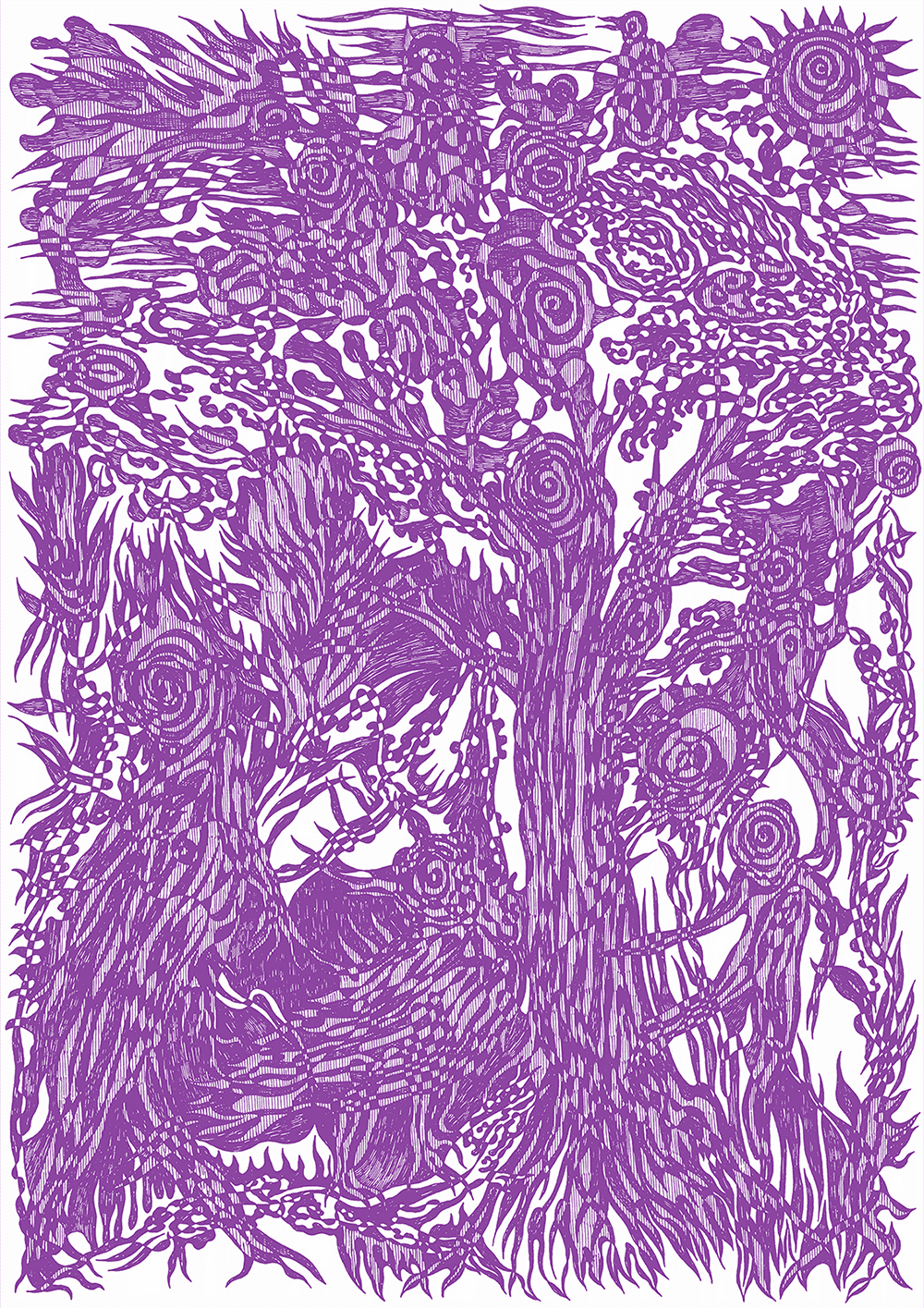
Drawing: ©Anaëlle Clot.
More than a technical notion, the interface invites us to rethink our relationship with matter: “In this sense, the interface is the product of a two-way relationship in which two bodies in reciprocal interaction merge to form a hybrid material that is different from its component parts. Even more significant is the fact that the interface is not an exception: it is not a behaviour of matter observed only under specific, rare conditions. On the contrary, in our experience of the materials around us, we only ever deal with the interface they construct with us. We only ever touch the surface of things, but it is a three-dimensional and dynamic surface, capable of penetrating both the object before us and the inside of our own bodies.”
The act of “touching” is also central to the thinking of philosopher and physicist Karen Barad. In her book On Touching – The Inhuman that Therefore I Am, Barad explains that, from the point of view of classical physics, touch is often described almost as an illusion: indeed, the electrons that make up the atoms of our hands and the objects we touch never actually meet but repel each other due to electromagnetic force. This means that any contact experience always occurs at a minimum distance, thus defying our sensory intuition.
Barad goes even further by analysing the question through quantum field theory, which introduces the possibility that matter is not something static and defined, but rather a continuous tangle of relationships and possibilities. The separation, which seems obvious to us, between one body and another fades away, because the boundaries between the “self” and the “other” are continually redefined, in a process that Barad calls intra/action and which would constitute the very essence of our reality – a reality where everything is constantly co-produced and co-determined. This principle implies that identity is not something pre-established but the result of infinite variations and transformations, according to a queer and non-binary model.
These approaches invite us to rethink our relationship with everyday objects and with matter in general. If matter has an agency of its own, we must recognise our belonging to a complex and interconnected system, with philosophical, political and ecological implications. Accepting that matter shapes us as much as we shape it, implies increased responsibility for our technological and environmental impact and, ultimately, for ourselves, as we inhabit assemblages, interfaces and intra/actions.
Intimity Among Strangers
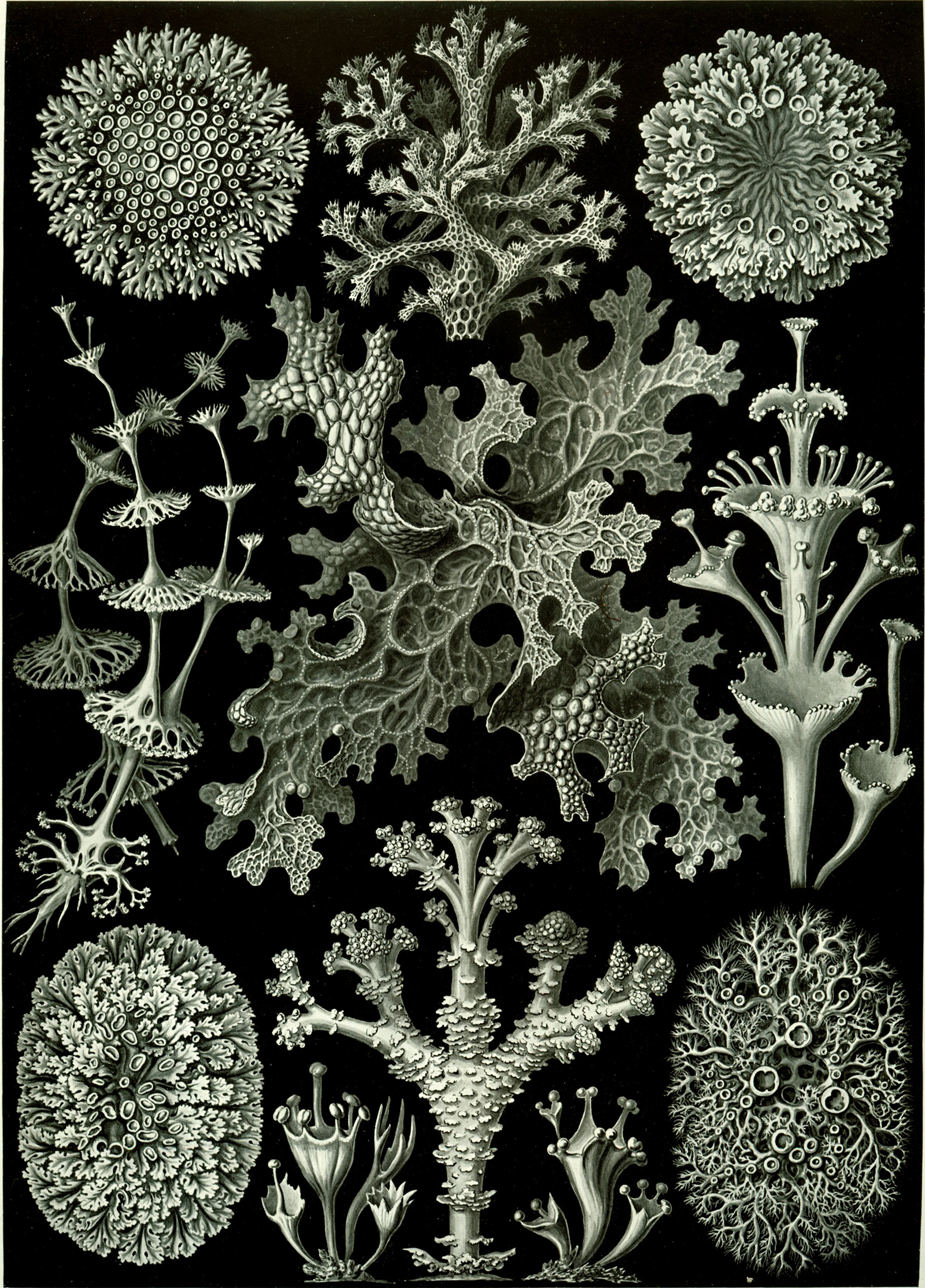
Covering nearly 10% of the Earth’s surface and weighing 130.000.000.000.000 tons—more than the entire ocean biomass—they revolutionised how we understand life and evolution. Few would probably bet on this unique yet discrete species: lichens.
Four hundred and ten million years ago, lichens were already there and seem to have contributed, through their erosive capacity, to the formation of the Earth’s soil. The earliest traces of lichens were found in the Rhynie fossil deposit in Scotland, dating back to the Lower Devonian period—that of the earliest stage of landmass colonisation by living beings. Their resilience has been tested in various experiments: they can survive space travel without harm; withstand a dose of radiation twelve thousand times greater than what would be lethal to a human being; survive immersion in liquid nitrogen at -195°C; and live in extremely hot or cold desert areas. Lichens are so resistant they can even live for millennia: an Arctic specimen of “map lichen” has been dated 8,600 years, the world’s oldest discovered living organism.
Lichens have long been considered plants, and even today many interpret them as a sort of moss, but thanks to the technical evolution of microscopes in the 19th century, a new discovery emerged. Lichen was not a single organism, but instead consisted of a system composed of two different living things, a fungus and an alga, united to the point of remaining essentially indistinguishable. Few know that the now familiar word symbiosis was coined precisely to refer to this strange structure of lichen. Today we understand that lichens are not simply formed by a fungus and an alga. There is, in fact, an internal variability of beings involved in the symbiotic mechanism, frequently including other fungi, bacteria and yeasts. We are not dealing with a single living organism but an entire biome.
Symbiosis’ theory was long opposed, as it undermined the taxonomic structure of the entire kingdom of the living as Charles Darwin had described it in On the Origin of Species: a “tree-like” system consisting of progressive branches. The idea that two “branches” (and, moreover, belonging to different kingdoms) could intersect called everything into question. Significantly, the fact that symbiosis functioned as a mutually beneficial cooperation overturned the idea of the evolutionary process as based on competition and conflict.
Symbiosis is far from being a minority condition on our planet: 90% of plants, for example, are characterised by mycorrhiza, a particular type of symbiotic association between a fungus and the roots of a plant. Of these, 80% would not survive if deprived of the association with the fungus. Many mammalian species, including humans, live in symbiosis with their microbiome: a collection of microorganisms that live in the digestive tract and enable the assimilation of nutrients. This is a very ancient and specific symbiotic relationship: in humans, the genetic difference in the microbiome between one person and another is greater even than their cellular genetic difference. Yet the evolutionary success of symbiotic relationships is not limited to these incredible data: it is the basis for the emergence of life as we know it, in a process described by biologist Lynn Margulis as symbiogenesis.
Symbiogenesis posits that the first cells on Earth resulted from symbiotic relationships between bacteria, which developed into the organelles responsible for cellular functioning. Specifically, chloroplasts—the organelles capable of performing photosynthesis—originated from cyanobacteria, while mitochondria—the organelles responsible for cellular metabolism—originated from bacteria capable of metabolising oxygen. Life, it seems, evolved from a series of symbiotic encounters, and despite numerous catastrophic changes in the planet’s geology, atmosphere and ecosystems across deep time, has been flowing uninterruptedly for almost four billion years.
Several scientists tend to interpret symbiosis in lichens as a form of parasitism on the part of the fungus because it would gain more from the relationship than the other participants. To which naturalist David George Haskell, in his book The Forest Unseen, replies, “Like a farmer tending her apple trees and her field of corn, a lichen is a melding of lives. Once individuality dissolves, the scorecard of victors and victims makes little sense. Is corn oppressed? Does the farmer’s dependence on corn make her a victim? These questions are premised on a separation that does not exist.” Multi-species cooperation is the basis of life on our planet. From lichens to single-celled organisms to our daily lives, biology tells of a living world for which solitude is not a viable option. Lynn Margulis described symbiosis as a form of “intimacy among strangers”: what lies at the core of life, evolution and adaptation.
A Sub-Optimal World
Olivier Hamant is a transdisciplinary biologist and researcher at the National Research Institute for Agriculture, Food and the Environment (INRAE) in Lyon, and is engaged in socio-ecological education projects at the Michel Serres institute.
His book “La Troisième Voie du Vivant” envisions a “sub-optimal” future to survive the environmental crisis: in this interview, he promotes the values of slowness, inefficiency and robustness, and invites us to embrace a certain degree of chaos.
Authors and philosophers have always been inspired by the observation of nature to speculate about reality and society, but often with an instrumental approach. You too are inspired by nature, but from your point of view as a biologist, you come to some conclusions that challenge our prejudices on how nature works. How did your questioning begin?
During my PhD I worked on plant molecular biology, looking at genetic control and information. It was a clear example of an industrial framework transposed to biology: we used organigrams, we drew cascades of genes, we discussed “lines of defence,” “metabolic channelling” … Such semantics implied that life is like a machine. When I finished my PhD, I decided to try out a more integrated and interdisciplinary approach to get a more systemic view of biology. This confirmed that what I thought I knew was wrong: I’d been polluted by the concept of living beings as machines, and that’s where I started to deviate.
The book is, in fact, a real lesson in “unlearning,” as you overturn some contemporary concepts that may seem positive but ultimately aren’t, such as “optimisation.”
Optimisation is the archetype of reductionism: to optimise, you first need to reduce a given problem in order to solve it. When we solve small problems, we usually create other issues elsewhere. Take the Suez Canal for example: that’s a form of optimisation, of sea transport here, that makes us very vulnerable. A single boat gets stuck across the canal, and that’s it, you can’t send anything between Asia and Europe.
What about “efficiency”?
Photosynthesis is probably the most important metabolic process on Earth: it has existed for 3.8 billion years, and it’s the root of all biomass and civilisation. The “performance” of photosynthesis is usually less than 1%: plants waste more than 99% of solar energy. They’re really, really inefficient. Plants are green because they don’t absorb all the light; they absorb the red and blue sections of the light spectrum (the edge of the spectrum) and reflect the green part. Why do they waste so much energy? It’s now recognised that this is a response to light fluctuation. Light isn’t stable and capturing the red and blue sections allows plants to face such fluctuations. Plants manage variability before efficiency. They build robustness against performance.
Today, we see that the world is unstable, and it will become more so in the future: we shouldn’t be focusing on efficiency but on robustness. When we look for inspiration from biology, we often focus on circularity and cooperation. It’s a good start, but if we overlook robustness, it won’t work. For instance, if we come up with a form of efficient circularity, we won’t have enough wiggle room for extreme events, and we’ll exhaust the available resources anyway. If we make cooperation efficient, the win-win result will be counterproductive, and some will be left behind. Thus, robustness is the most important principle because it makes circularity and cooperation operational.
The most substantial criticism in your book concerns performance, drawing a parallel between violence against the environment and burnout.
Performance generates burnout—it’s a typical effect. Burnout applies to a person or an ecosystem. The path towards burnout is sufficient to condemn “efficiency at all costs,” but performance is also counterproductive in many other ways. A typical example is sports competitions: you want to be number one, you’ll do anything, including doping or cheating. That has nothing to do with sport and it’s detrimental to your health and career.
You also take concepts we interpret negatively and explain how they are actually positive, such as slowness or hesitation…
Slowness and hesitation are the keys to competence, as might be illustrated by stem cells. Biologists have focused on these cells for a long time because they’re extraordinary: they can renew all kinds of tissues. For a long time, we thought this was all controlled by a tidy organigram. It turns out that one of the key elements is that they’re slow: they hesitate all the time, and because they hesitate, they can do anything. Delays give some breathing space. I would actually go one step further: slowness is an essential lever for transformation. To change, you first need to stop. It’s like being in a car at a crossroads; if you want to change direction, you need to stop, indicate and turn. If you don’t stop, you won’t change.
Change is the keyword here. Hard science, numbers and prediction systems often lack the ability to consider contingencies or change, giving us the illusion that we have some form of control over reality.
Thankfully, we’ve made progress and now we use numbers to understand the unpredictability of the world (instead of using numbers to control it). For instance, in the lab, we’re working on the reproducibility of the shapes of organs. In a tulip field, all flowers look alike. You could think of an IKEA-like process: building things in the same way also makes them replicable. But this isn’t the case for living systems: when a flower emerges, some cells divide, others die, molecules come and go… Basically, it’s a mess. In the end, the miracle is that you get a flower with the same shape, colour and size as the neighbouring one. We showed that the flower uses and even promotes all kinds of erratic behaviours, precisely because they provide valuable information, to reach that reproducible shape. Once again, they build robustness against performance.
So, a certain degree of chaos should be embraced?
Sociologist Gilles Armani once told me a story about how to deal with impetuous rivers. The Rhône has all these swirls: if you don’t know how to swim through them, you might get trapped and drown. When people were used to living with rivers, if caught in the water flow, they wouldn’t fight it: they’d take in some air, let themselves be taken down by the swirl and the river would then let them out somewhere else, until they reached the shore. In a fluctuating world, the aim is no longer reaching one’s destination as quickly as possible, but rather viability, something which should be based not against, but on turbulence.
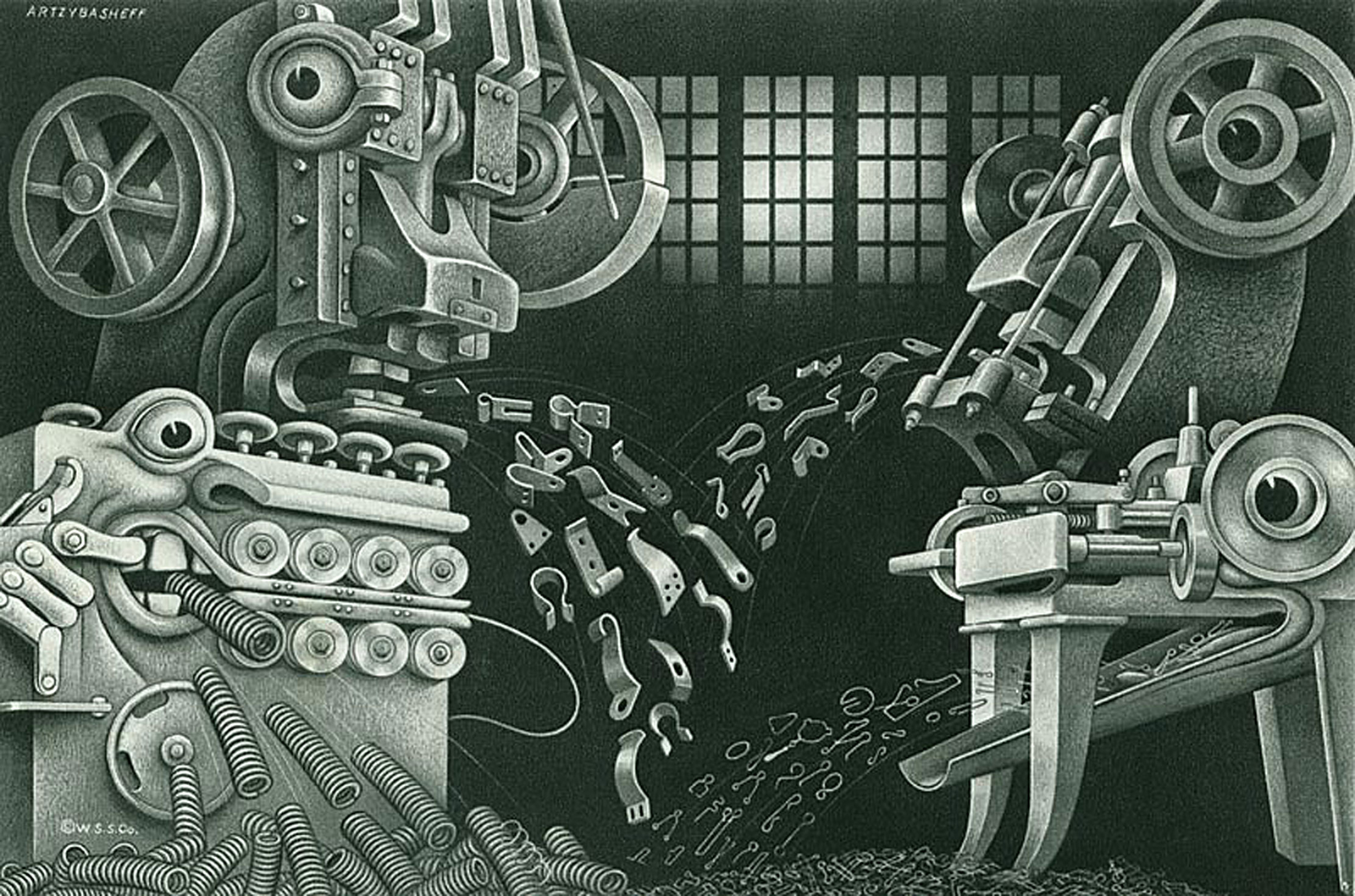
Image: Boris Artzybasheff.